
When economist look back on the post-pandemic economic era, they may conclude that the most important story was not inflation, artificial intelligence, or even geopolitics. It was the return of the bond market.
For more than a decade after the Global Financial Crisis, investors lived in a world of exceptionally cheap money. Governments borrowed at historically low rates, homeowners became accustomed to inexpensive mortgages, and businesses expanded under favourable financing conditions. Today, that environment has changed dramatically. The UK’s 10-year gilt yield has moved above 5%, while the US 10-year Treasury yield has also risen beyond 5%, signalling a profound shift in market expectations about inflation, growth, government debt, and risk.
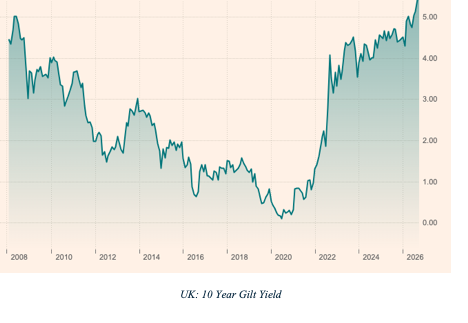
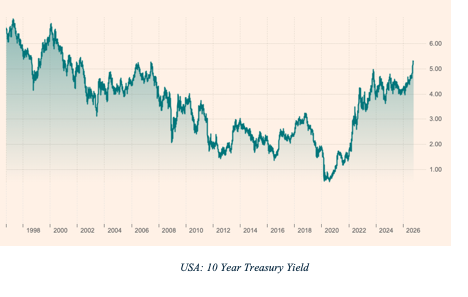
The significance of these developments cannot be overstated. Long-term bond yields represent the collective judgment of millions of investors. Unlike political speeches or policy announcements, bond markets have real money at stake. When investors demand over 5% to lend to governments for ten years, they are expressing concern that inflation, fiscal pressures, and economic uncertainty may persist longer than many policymakers previously anticipated.
A Visual Snapshot of the New Interest Rate Era
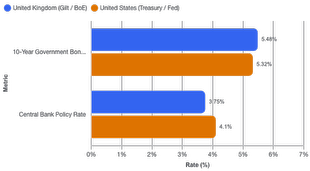
The chart highlights an important reality. Long-term bond yields now sit significantly above policy rates. Markets are therefore signalling that borrowing costs may remain structurally higher than those experienced throughout much of the 2010s.
Britain’s Economic Future: Stability Without Dynamism?
The United Kingdom enters the latter half of the decade in a complicated position. Inflation has fallen significantly from its peak, yet it remains above the Bank of England’s 2% target. The central bank recently held the Bank Rate at 3.75%, citing continuing concerns about energy-price volatility and the risk that higher costs could become embedded within wages and prices.
The bond market appears unconvinced that the inflation battle has been completely won. A gilt yield around 5.5% implies that investors continue to demand a substantial risk premium for holding UK government debt. That has consequences extending far beyond financial markets.
As existing government debt matures, new borrowing must increasingly be issued at higher interest rates. Consequently, a larger share of future tax revenues may be directed towards servicing debt rather than funding public services, infrastructure, education, or healthcare. The International Monetary Fund has repeatedly warned that high public debt and persistent fiscal deficits remain significant risks for advanced economies.
For households, the implications are equally profound. The era of 1% to 2% mortgage rates is unlikely to return. Even if the Bank of England gradually lowers short-term rates in coming years, mortgage pricing will continue to depend heavily on long-term market yields. As recent mortgage-market evidence demonstrates, lenders frequently raise fixed mortgage rates even when the Bank Rate remains unchanged because wholesale funding costs have increased.
My central expectation is that the UK avoids recession but struggles to achieve strong growth. Economic expansion is likely to remain modest, perhaps between 1% and 2% annually, while inflation fluctuates above target more frequently than policymakers would prefer. Living standards should improve gradually, but the pace is unlikely to match the optimism often associated with previous economic recoveries. This is not a crisis scenario. Rather, it is a prolonged period of adjustment to a world where money once again carries a meaningful cost.
The United States: Stronger Foundations, Similar Challenges
Across the Atlantic, the picture looks somewhat brighter. According to the latest projections from the Federal Reserve, the US economy is expected to achieve approximately 2.3% growth while maintaining unemployment close to 4.1%. At the same time, inflation is projected to move progressively towards the central bank’s long-run target.
Perhaps more importantly, the United States continues to benefit from structural strengths that are difficult for most other economies to replicate. The rapid expansion of artificial intelligence, advanced semiconductor manufacturing, cloud infrastructure, and digital services has generated a powerful investment cycle. The IMF specifically identifies AI-related investment as a major contributor to global growth, with North America positioned as one of the primary beneficiaries.
Yet even America faces an uncomfortable question. If economic conditions are genuinely improving and inflation is expected to return to target, why do long-term Treasury yields remain above 5%?
One explanation is that investors are increasingly concerned about the long-run consequences of persistent fiscal deficits. Another is that markets are beginning to accept that neutral interest rates may be higher than they were in the decade following the financial crisis. Either interpretation suggests that borrowing costs could remain elevated even if the Federal Reserve eventually eases policy.
My base-case outlook remains relatively optimistic. The United States is likely to continue outperforming the UK in terms of growth, innovation, productivity, and capital investment. While occasional market corrections remain inevitable, the broader trajectory points towards continued technological leadership and moderate economic expansion.
The Bond Market’s Warning
The most fascinating aspect of the current environment is the apparent disconnect between central-bank forecasts and bond-market pricing.
Official forecasts from both the Bank of England and the Federal Reserve suggest that inflation should gradually return to target over the coming years. Yet bond investors continue demanding historically elevated yields.
Markets appear concerned about the possibility that inflation proves more persistent than expected. They also appear worried about geopolitical instability, energy-market disruptions, mounting government debts, and the economic consequences of ageing populations and rising healthcare commitments. The IMF identifies all of these factors as meaningful risks to the global outlook.
Historically, bond markets have often recognised economic turning points before policymakers. Whether that proves true again remains uncertain, but the message currently emerging from sovereign debt markets deserves careful attention.
Conclusion: A New Economic Era
The rise of 5% government bond yields may ultimately prove more consequential than any single election, central-bank meeting, or stock-market rally.
For the United Kingdom, the future appears characterised by steady but modest growth, tighter fiscal constraints, and an extended adjustment to higher borrowing costs. For the United States, the outlook is more favourable, underpinned by innovation, productivity, and technological investment, though concerns about debt sustainability have not disappeared
The broader lesson is clear. The age of ultra-cheap money is fading into history. The next decade is likely to reward productivity, innovation, fiscal discipline, and prudent investment decisions far more than leverage and speculation. If the stock market tells us what investors hope for, the bond market tells us what they fear. Today, the bond market is speaking very loudly.


Leave a Reply